
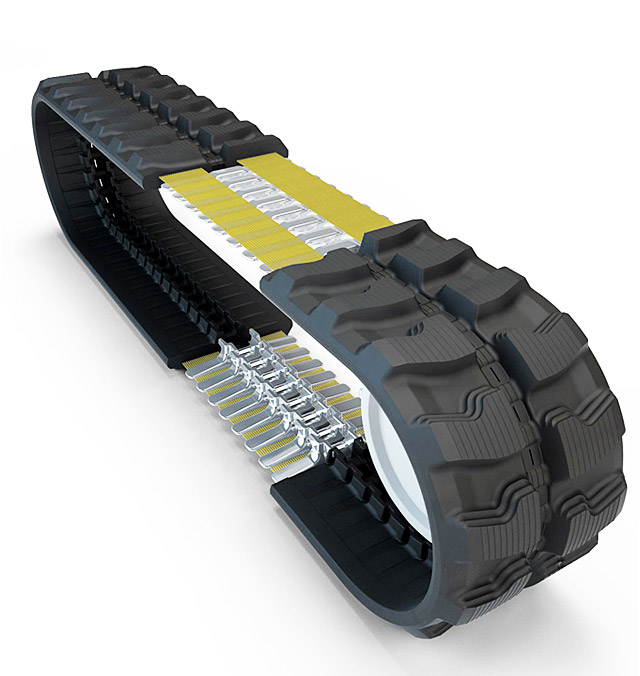
Rubber track size is measured using three numbers: width, pitch, and link count, written as a sequence like 300 × 52.5 × 84. Getting all three right prevents slippage, premature wear, and de-tracking. This guide covers mini excavators, compact track loaders and skid steer track loaders – how to measure your existing tracks and cross-reference them against your machine’s make and model before you order a replacement.
What Rubber Track Size Numbers Actually Mean
A rubber track size is made up of three measurements: width, pitch, and link count. Manufacturers write these as a sequence, such as 300 x 52.5 x 84, and all three numbers need to match your machine’s original specification for the track to fit correctly.
Width is the contact surface of the track, measured in millimetres from one edge to the other. Pitch is the distance between the centre of one drive lug and the centre of the next, which determines how the track engages with your machine’s drive sprocket. Link count is the total number of links needed to form one complete loop around the undercarriage.
All three numbers work together. A track with the correct width but the wrong pitch will still slip on the sprocket, and a track with the right width and pitch but the wrong link count won’t tension properly. That’s why suppliers list all three together rather than a single “size.”
Some track sizes also include a suffix, such as W, N, or K, to identify a specific track configuration. These designations can vary by manufacturer, so two tracks with the same width, pitch, and link count may not necessarily be interchangeable. We confirm the complete track specification against your machine before shipping.
Mini Excavator Track Sizes by Machine Class
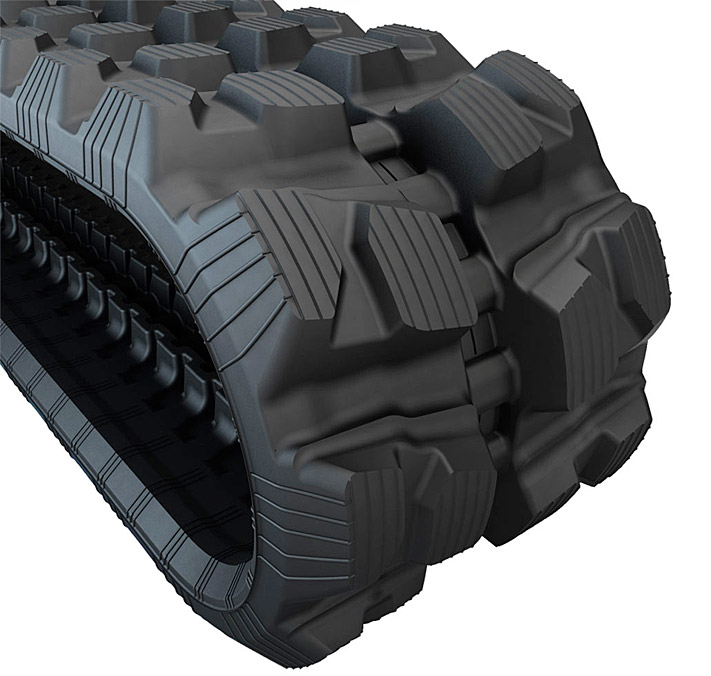
If you already know roughly what weight class your mini excavator falls into, the fastest route to your size is to find your range below. These are the configurations we stock and ship across Canada, grouped by machine weight class.
| Machine class | Common track sizes (Width × Pitch × Links) |
|---|---|
| Micro (0.8–2.0 t) | 180 × 72 × 31, 32, 33, 34, 35, 36, 37, 38, 39, 40, 41, 42, 43, 44, 45 230 × 48 × 60, 62, 63, 64, 66, 68, 70, 72 |
| Compact (2.0–3.5 t) | 230 × 72 × 37, 39, 40, 41, 42, 43, 44, 45, 46, 47, 48, 49, 50, 52, 54, 56 300 × 52.5 × 70, 72, 74, 76, 78, 80, 82, 84, 86, 88, 90, 92 |
| Mid (3.5–6.0 t) | 350 × 52.8 × 84, 86, 88, 90 400 × 72.5 × 68, 70, 72, 74, 76 |
| Large (6.0–8.0 t) | 450 × 81 × 74, 76, 78 |
Rarer sizes outside these ranges are available as well. If your machine isn’t covered here, send us your machine details and we’ll cross-reference the OEM specification for you.
You can also browse tracks by machine brand – Bobcat, Kubota, John Deere and Caterpillar – if you already know your machine make.
Compact Track Loader Track Sizes
Compact track loader sizes are organised differently. CTL tracks are grouped by track width rather than machine weight class, and they run on a narrower set of pitches, mostly 72 mm and 86 mm. These are the CTL configurations we stock:
| Track width | Common CTL track sizes (Width × Pitch × Links) |
|---|---|
| 180 mm | 180 × 72 × 37, 38, 39, 40, 41, 42, 43, 44, 45 |
| 230 mm | 230 × 72 × 37, 39, 40, 41, 42, 43, 44, 45 |
| 320 mm | 320 × 86 × 49, 50, 52, 53 |
| 400 mm | 400 × 86 × 49, 50, 52, 53, 56 |
| 450 mm | 450 × 86 × 52, 55, 56, 58, 60 |
Compare the 400 mm rows in the two tables. A 400 mm CTL track runs an 86 mm pitch with 49 to 56 links; a 400 mm mini excavator track runs a 72.5 mm pitch with 68 to 76 links. Same width, different machine, completely different track. That is the clearest reason the width on its own never confirms fitment.
How to Measure Your Current Tracks
The quickest place to check is your existing track itself: the size is often moulded into the sidewall. If it’s legible, that’s your answer and you can skip the measuring entirely.
If the sidewall is worn smooth, or you want to confirm fitment before ordering, you can measure directly. Here’s the process:
- Measure the width across the tread, from one outer edge to the other, in millimetres.
- Count the internal drive lugs/links around one complete loop of the track. Marking your starting point can help ensure you don’t lose count.
- Measure the pitch by finding the centre of one drive lug and measuring to the centre of the next lug in the sequence.
- Record all three numbers together in the standard format (width x pitch x link count), the same way manufacturers list it.
Heavy wear or damage can make an existing track more difficult to measure accurately. If your measurements are unclear or fall between common sizes, send us your machine’s make, model, and serial number and we’ll confirm the correct fitment. You can also browse mini excavator tracks by machine model.
Mini Excavator vs. Compact Track Loader Sizing Differences
Mini excavators and compact track loaders both run on rubber tracks, and the widths overlap more than people expect – both run from 180 mm up to 450 mm. Width is not what separates them. Pitch and link count are.
Compact track loader tracks are built around a 72 mm or 86 mm pitch, with relatively low link counts – typically 37 to 60. Mini excavator tracks use a wider spread of pitches – 48, 52.5, 52.8, 72 and 81 mm – with much higher link counts, up to 92.
A 400 mm track is the clearest example. On a compact track loader that is 400 × 86 × 49 through 400 × 86 × 56. On a mini excavator it is 400 × 72.5 × 68 through 400 × 72.5 × 76. Same width, different pitch, different link count – not interchangeable, even though the first number matches.
That is why the width on its own never confirms fitment. Always confirm all three numbers against your specific machine and model, whether it is a mini excavator or a CTL.
Core Construction and Machine Design
Two things beyond the three numbers affect which track will actually fit and last: how the track is built, and what your machine was designed to run.
Steel core tracks use steel plates and cables embedded in the rubber carcass, creating a steel skeleton for maximum toughness and rigidity. Non-steel core tracks are lighter, reinforced with polyester cables instead, and offer more flexibility – they are commonly used on multi-terrain loaders.
Machine design matters too. Equipment built for rubber tracks only generally runs a pitch in the 60 mm to 150 mm range. Equipment designed to take either rubber or steel tracks runs a wider range, from 48 mm up to 167 mm. That is worth knowing before you order, because it changes which pitch values are even valid for your machine.
Tag Equipment supports both categories, with sizing matched to OEM specifications for each. See our compact track loader rubber tracks range if you’re sourcing for a loader rather than an excavator.
OEM vs. Aftermarket Rubber Tracks: What Actually Changes
The biggest difference between OEM and aftermarket rubber tracks is not price – it is whether the track has been properly cross-referenced to your machine before it ships.
OEM tracks are specified for a particular machine application. Aftermarket tracks from manufacturers such as CAMSO, ITR and Traxter are built to match the same specification, and Tag Equipment supplies them as OEM-spec tracks at aftermarket pricing, backed by a non-prorated warranty.
The real question is not OEM versus aftermarket in general – it is whether the track you are buying has been confirmed against your machine. A correctly matched aftermarket track performs the way an OEM track would. An incorrectly matched one causes slippage, premature wear, poor tensioning and de-tracking, whatever the brand on it.
That’s why correct fitment should be one of the first things you confirm when choosing a replacement rubber track. See our full rubber tracks range for options across major equipment brands.
Getting the Right Fit the First Time
Measuring your own tracks is a useful first step, but confirming fitment before you order is what actually prevents a wrong-size delivery. The fastest way to do that is to provide your machine’s make, model, and serial number, along with your measurements if you have them.
Tag Equipment cross-references this information against OEM data for a wide range of mini excavator and compact track loader brands. We verify four things before a track ships – width, pitch, link count and drive lug spec – against your exact machine, not just a generic size match. Request a quote with your machine’s details and we will confirm the correct track size before it ships.